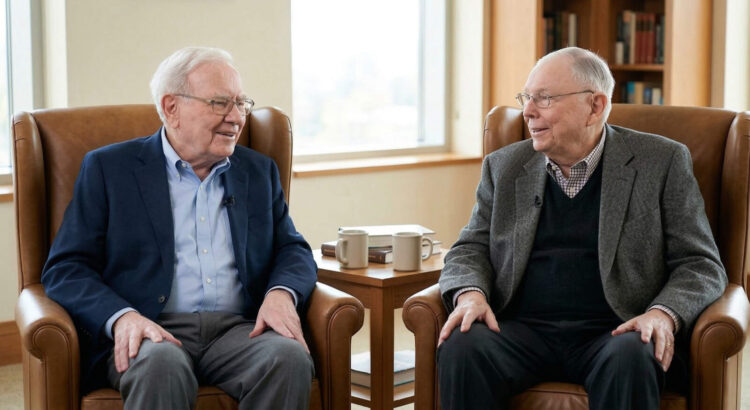
Warren Buffett is widely considered the greatest investor of all time, but the version of Buffett that most people know is not the one who started it. The early Buffett was a disciplined disciple of Benjamin Graham, buying statistically cheap stocks without regard for the quality of the business.
It was the late Charlie Munger who changed all that. Buffett has repeatedly said that Munger fundamentally changed his approach to investing, moving it away from Graham’s “cigar butt” style and toward something much more robust and durable. Here are five lessons Munger taught Buffett that changed everything.
1. Transition From Cheap Stocks to Great Businesses
In the 1950s and 1960s, Buffett operated almost entirely within Graham’s framework. He looks for companies that are trading below their intrinsic value based solely on statistics, regardless of whether the underlying business is worth owning for the long term. It works, but there are limits.
Munger argued that truly great businesses would add wealth over decades, and that chasing mediocre companies just because they were cheap was a mistake. Buffett credited this change directly to Munger: “Charlie encouraged me not to just buy cheap stuff, as Ben Graham taught me. This is the real impact he had on me.”
This philosophical evolution prompted Berkshire Hathaway to invest in companies like Coca-Cola, which Buffett owned for decades and generated huge long-term profits.
2. Maintain a successful business forever rather than selling at fair value
Graham’s method usually involves buying cheap shares and selling them after reaching a reasonable valuation. The goal is turnover and discount realization. Munger challenges Buffett to see this as a fundamental limitation and not a feature.
Munger’s view is that selling a good business simply because it has reached fair value means giving up all future profits that the business will generate. Buffett described the change:
On Charlie Munger’s Influence:
“The blueprint he gave me was simple: Forget what you know about buying fair businesses at a good price; instead, buy good businesses at a fair price.” — Letter to Shareholders 2014.
“Charlie encouraged me not to just buy cheap stuff… It took a powerful force to divert me from Graham’s restrictive views. It was the power of Charlie’s mind.” — Forbes interview, 1996.
“When we own some great businesses with great management, our favorite ownership period is forever.” — 1988 Letter to Shareholders.
That single idea became one of the defining principles of modern Berkshire Hathaway.
3. Business Quality Is More Important Than Balance Sheet Discounts
Graham’s approach places great emphasis on balance sheet metrics such as book value, net current assets, and liquidation value. These are measurable and conservative measures, but they hardly tell us whether a business has the capacity to grow and protect its profits over time.
Munger turned Buffett’s attention to economic resilience and competitive forces. He wants Buffett to ask not only whether a company is cheap now, but whether the company can maintain and grow its earnings in the years to come.
Buffett once said, “Charlie encouraged me not to just buy cheap things… It was the power of Charlie’s mind” that shifted his focus to businesses with moats. This thinking gave rise to Buffett’s concept of an economic moat, which is a long-lasting competitive advantage that protects a business from competitors.
4. Management Quality Is a Core Investment Criteria
Graham’s classic investing is largely a numbers exercise. If the balance sheet is cheap enough, the quality of the people running the company is almost second place. Munger believes that approach misses something important about how businesses actually succeed or fail over time.
He encouraged Buffett to evaluate the character, abilities and integrity of the people in charge. Over time, Buffett fully embraced this standard and incorporated it into Berkshire’s acquisition framework. He later described the approach as follows: “Charlie and I look for three things in a business: we look for a business we can understand, profitable long-term economics, and capable and trustworthy management.” That three-part standard now shapes every major decision Berkshire makes.
5. Applying Various Mental Models Across Disciplines
Munger wasn’t just a better version of a Graham-style investor. He was a voracious student of psychology, history, mathematics, biology, and physics, and he believed that truly good thinking required the application of all. He introduced Buffett to the concept of building a grid of mental models from various fields.
Munger articulated his own philosophy: “You have to have a model in your head. And you have to structure your experience in the grid of this model.” Buffett admits to adopting a multidisciplinary approach in his decision making. This expands its analytical tools far beyond any field, including finance, that it could provide on its own.
Conclusion
The partnership between Warren Buffett and Charlie Munger is one of the most important relationships in investment history. Buffett came with the extraordinary foundation of Benjamin Graham, but Munger built on it and developed it to make Berkshire Hathaway what it is today.
Buffett is candid about his debt: “Charlie’s true genius steered me away from the idea of buying a bad business just because it was cheap.” And in perhaps the most direct summary of Munger’s impact, Buffett said: “Berkshire would have been a lot poorer if Charlie hadn’t joined me.” For any investor looking to build lasting wealth, these five lessons are not just history. It’s a blueprint.
PakarPBN
A Private Blog Network (PBN) is a collection of websites that are controlled by a single individual or organization and used primarily to build backlinks to a “money site” in order to influence its ranking in search engines such as Google. The core idea behind a PBN is based on the importance of backlinks in Google’s ranking algorithm. Since Google views backlinks as signals of authority and trust, some website owners attempt to artificially create these signals through a controlled network of sites.
In a typical PBN setup, the owner acquires expired or aged domains that already have existing authority, backlinks, and history. These domains are rebuilt with new content and hosted separately, often using different IP addresses, hosting providers, themes, and ownership details to make them appear unrelated. Within the content published on these sites, links are strategically placed that point to the main website the owner wants to rank higher. By doing this, the owner attempts to pass link equity (also known as “link juice”) from the PBN sites to the target website.
The purpose of a PBN is to give the impression that the target website is naturally earning links from multiple independent sources. If done effectively, this can temporarily improve keyword rankings, increase organic visibility, and drive more traffic from search results.